


Typically, you should issue at least two copies of a GST bill format. One goes to the buyer, and the other is for your records. If you are dealing with goods, you may also need a copy for transportation, as required by the GST bill format.

GST Invoice Rules and Billing Format with Examples
A guide on GST Invoice Rules and Billing Format. Know Types of GST Invoice, how to personalize GST invoice & difference between new GST Invoice & Old Invoice.
Key takeaways:
Do you know about the five key components of a GST billing format? Read and learn about the legally mandating elements of a GST billing format.
There are various types of GST invoices, such as Tax Invoices, Bills of Supply, Aggregate Invoices, and Credit/Debit Notes to look out for. Want to know which is crucial for filing ITC? Read and find out.
GST, or Goods and Services Tax, has simplified India’s tax system by easing the cascading effects of the taxes. Before GST, businesses were subjected to various taxes like VAT, service tax, and excise duties, complicating the process. But now, it’s relatively simpler.
GST invoices and billing formats are vital for filing tax returns within the GST tax regime. This blog covers GST invoices, what they are, what they look like, their types, and new rules. Don't worry; we have included enough examples to deepen your understanding.
So, before we jump into GST invoice rules, let’s understand what a GST invoice is.
What is a GST Invoice?
A GST invoice is a legal document issued by registered businesses (or sellers) when goods or services are sold. It gives a detailed breakdown of the items or services purchased and the applicable taxes. For GST-registered businesses, issuing GST invoices for taxable sales is a must. This keeps everything in line with the law and ensures taxes are properly collected.
At Amazon Business, we provide GST invoices with every business purchase to make your tax filing simpler.
Who Should Issue a GST Invoice?
Sellers registered under GST must issue a GST invoice for every taxable transaction when selling goods. Under GST invoice rules, registered sellers must follow a specific GST billing format. Similarly, vendors registered with the GST council with their unique GSTIN (GST Identification Number) must issue purchase bills in the prescribed GST billing format.
The GST number (GSTIN) is a 15-digit unique code assigned to businesses under GST.
Special Cases Under GST Invoices
Specific special cases under GST invoices require different GST billing formats and procedures.
Reverse Charge Mechanism (RCM): Under RCM, the recipient creates a self-invoice instead of the supplier issuing a GST invoice.
Composition Scheme: Businesses under the composition scheme use a GST billing format with a bill of supply, not a tax invoice, as they pay tax at a fixed rate without GST charges.
Exports: GST billing format for exports must include the declaration:
"Supply meant for export on payment of IGST."
"Supply meant for export under bond/letter of undertaking without IGST."
Zero-Rated or Exempt Supplies: A bill of supply is issued instead of a GST invoice for zero-rated or exempt supplies.
Unregistered Buyers: When selling to unregistered buyers for ₹50,000+, the GST billing format must include their name, address, and place of delivery.
Here’s An Example of a GST Billing Format
Creating a GST billing format in Excel and Word is simple and popular, making it easy for businesses to create invoices quickly and correctly.
Here’s a bill sample with GST to help you understand the typical GST bill format:

What Are The Mandatory Fields in GST Invoice?
Know the prescribed GST billing format
As per the GST invoice rule, some key details must be included in a GST billing format to keep things legitimate. Here’s a quick breakdown of what a GST billing format mandates:
Supplier Details: Supplier’s name, GSTIN, address, and place of supply where the goods or services are being provided.
Recipient Details: Recipient’s full legal name, GSTIN, complete address, and shipping address.
Invoice Details: Invoice number, date, and unique invoice reference Number (if needed).
Description of Goods/Services: (HSN) code for goods or SAC for services. A clear description of the goods or services supplied, quantity, unit price, and total value (before taxes).
Taxation Details: The taxable value of goods/services before tax, the GST rate (CGST, SGST, or IGST), and the GST amount (CGST, SGST, IGST) calculated on the taxable value.
Tax Calculation: CGST, SGST, and IGST(for interstate transactions) amounts per the applicability.
Total Invoice Amount: To avoid confusion or fraud, total (including taxes) and the total amount in words.
Payment Terms: Due date for payment and payment mode
Signature of Seller: The person authorized to issue the invoice must sign it manually or digitally.
Types of GST Invoice
GST invoices might look like another piece of paperwork, but they are important for keeping business transactions in check. Each type has its own role, depending on the kind of transaction.
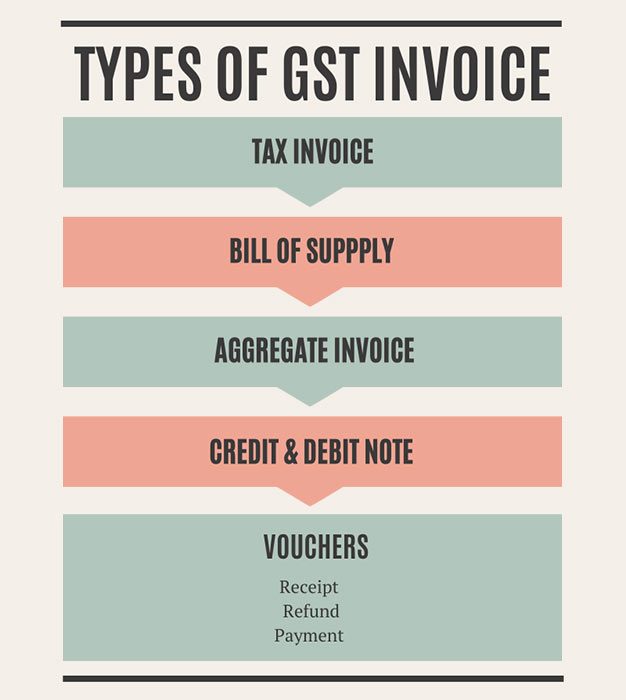
1. Tax Invoice
As per GST invoice rules, any business registered under GST must provide a tax invoice when supplying goods or services. It is raised unless the transaction amount is under ₹200. If the sale exceeds this amount, the tax invoice needs to be issued within the next 30 days of the supply date.
It details what’s being sold, how much it costs, and the GST added, making sure everything’s clear and correct. Buyers can’t claim input tax credits without it, so it’s a must-have for any GST transaction.
2. Bill of Supply
It's the same as a tax invoice but without any GST because these transactions aren’t subject to tax. The bill of supply is issued in two cases: when you're registered under the composition scheme or when the goods or services you're selling are exempt from GST.
3. Aggregate Invoice
An aggregate invoice sums up all sales below ₹200 for the day into one neat document. This type of invoice is for small transactions that don’t need individual invoices.
According to GST rules, this aggregate invoice can only be issued to an unregistered buyer.
4. Credit & Debit Note
If you overcharged, issue a credit note to refund or adjust the extra amount. If you are undercharged, a debit note fixes that by adding the missing amount. This invoice can be used whenever you need to adjust a GST billing format after it’s been issued.
5. Receipt, Refund, Payment Voucher
When managing transactions under GST, there are different types of vouchers that businesses may need to issue depending on the situation:
Receipt Voucher is used when a customer pays in advance for goods or services they haven’t received yet.
Refund Voucher used to return money after a canceled order
Payment Voucher is for when you pay suppliers. It confirms the payment and includes all the important details, like how much was paid and who it was for.
To learn more about why GST invoicing is essential, check out the blog on the Advantages of GST.
GST Invoice Rules
GST invoice rules basically set the ground rules for creating invoices under the Goods and Services Tax (GST) system. They keep things clear, organized, and in line with the law. These rules are part of the Central Goods and Services Tax (CGST) Act, 2017, and the state-level acts, covering the required details to formats and timelines for invoices.
They’re designed with input from the GST Council, businesses, tax experts, and people who know the industry to make sure they actually work in real life. The aim is to standardize invoicing across industries so compliance is simpler. Since things are always changing, these rules get updated regularly to stay current with tech, feedback, and evolving business needs.
To access Amazon’s GST invoice again, read about the GST registration process.
Key GST Invoice Rules to be Mindful About
HSN Code Requirement: Businesses must include the HSN code based on turnover. For up to ₹5 Crore 4-digit HSN code and above ₹5 Crore, 6-digit HSN code.
E-invoicing is mandatory for businesses with an Annual Aggregate Turnover (AATO) exceeding ₹5 crore. Each invoice must have a valid Invoice Reference Number (IRN) registered on the Invoice Registration Portal (IRP).
B2C Invoices & QR Codes: All B2C invoices must include a dynamic QR code for easy digital payment processing.
Input Tax Credit (ITC) can only be claimed if the invoice is reported to the GST portal by the supplier and appears in the buyer's GSTR-2B.
For inter-state transactions, the place of supply must be clearly mentioned to determine the correct tax (IGST vs. CGST+SGST).
Time of Issue: Goods: Invoice must be issued before or at the time of delivery. Services: Invoice must be issued within 30 days of service completion.
Retention of Invoices: Businesses must retain all GST invoices for at least 8 years from the date of filing the annual return.
Late Fees for Non-Compliance: Incomplete or non-compliant invoices may attract penalties or late fees as per the GST Act.
Self-Invoicing for RCM: For reverse charge mechanism (RCM) transactions, the recipient must issue a self-invoice to pay the tax.
Mandatory Multi-Factor Authentication (MFA) is mandatory for taxpayers with an Annual Aggregate Turnover (AATO) exceeding ₹20 Crore.
Time Limit for Reporting E-Invoices: Businesses with an AATO exceeding ₹10 Crore must report e-invoices to the IRP within 30 days from the date of invoice generation.
Restrictions on E-Way Bill Generation: E-Way Bills can only be generated for documents dated within 180 days from the date of E-Way Bill generation.
Revising an already-issued tax invoice
Let’s say you’ve already issued a tax invoice, but something’s off—maybe the tax rate is wrong, or you missed a product. The good news? You can revise the GST billing format, but it’s not just as easy as hitting “edit.” There’s a proper process.
You need to issue a credit note if you're reducing the value or a debit note if you need to increase it. These notes adjust the original GST billing format so that both you and your customer have the correct records.
After that, a fresh invoice reflecting the changes is issued. This keeps everything updated and helps you avoid any issues during audits.
How to Personalize GST Invoices?
While GST invoices need to be compliant, the GST billing format still allows for some personalization to make them stand out.
Here’s what you can do:
Include your company logo at the top
Use a clean and organized layout to make the invoice easy to read
If applicable, add payment terms, discounts, or customer references to make your invoices more informative.
Key Differences Between the New GST Billing Format and Old Billing Format
Aspect | Old-GST Billing Format | New GST Billing Format |
Tax Identification Numbers | Utilized various tax IDs like TIN (Taxpayer Identification Number) for VAT and Service Tax numbers. | Requires GSTIN for both supplier and recipient. |
Tax Structure | Included are separate taxes such as VAT, service tax, excise duty, etc., each listed individually. | Consolidates taxes into CGST, SGST, and IGST, clearly itemized on the invoice. |
HSN/SAC Codes | Not mandatory; varied by state regulations and type of goods/services. | Mandatory inclusion of HSN codes for goods and SAC for services based on turnover thresholds. |
Invoice Numbering | Varied formats without a standardized structure; no requirement for uniqueness per financial year. | Requires a unique, consecutive serial number for each financial year, not exceeding 16 characters, which may include alphabets, numerals, and specific special characters. |
Reverse Charge Mechanism | Applied in limited scenarios, primarily for services not uniformly implemented across states. | Clearly mandates indication of reverse charge applicability on the invoice, applicable to specified goods and services. |
Invoice Issuance Timelines | Differed based on state laws and type of tax; no uniform standard across the country | Specifies strict timelines: for goods, on or before the date of removal or delivery; for services, within 30 days (45 days for banks and financial institutions) from the date of supply. |
Digital Invoicing | Limited adoption; electronic invoicing was not standardized or widely practiced. | Encourages e-invoicing for businesses with turnover above specified thresholds, promoting digital record-keeping and real-time reporting. |
Input Tax Credit (ITC) | Complex and varied credit mechanisms for different taxes; cross-utilization restrictions. | Streamlined ITC process with seamless credit across goods and services, provided invoices meet GST compliance requirements. |
How to Issue a GST Invoice?
Prepare the GST Billing Format: Use accounting software or manual templates that follow GST guidelines.
Assign a Unique Invoice Number: Ensure the GST billing format has a sequential, unique number for tracking and compliance.
Ensure Timely Issuance: Issue the invoice on time, on or before delivery of goods, and within 30 or 45 days (for banks/NBFCs) after providing services.
Distribute the Invoice: Send the recipient a signed copy of the invoice and keep a copy for yourself to have on hand for future reference.
Time Limit for Issuing a GST Invoice
When you need to issue a GST invoice, the timing depends on whether you're dealing with goods or services:
For Goods
Regular supply: The invoice must be issued by the date of delivery or removal of goods.
Continuous supply of goods: The invoice should be issued on or before the date when the account statement or payment is due.
For Services
General cases: The invoice must be issued within 30 days from the date of providing the service.
Banks and NBFCs: They have a relaxed timeline and must issue the invoice within 45 days from the date of service.
How to Add GST No. in Amazon Business?
With Amazon Business, any business can add their GST number in the following simple steps:
Go to Amazon Business website and sign into your account
Click on your profile name or account icon in the upper-right corner
Select Business Settings from the drop-down menu
Navigate to the GST section on the same page and click on Manage GST
Choose Add GST number and enter your 15-digit GSTIN
Enter your legal business name and registered address
Select the state where your business operates
Click on Save to confirm the details
All registered GST numbers will be listed under the Manage GST section. In case you need to modify the existing GST number, follow these steps:
Click on the Manage option next to the listed GSTIN
You can edit the address, phone number, or remove the GST number as needed
Pro Tip: For businesses with operations in more than one state, remember to enter the GST number and corresponding addresses for every state. This will ensure you pay the right GST on items shipped from other states.
How to Order on Amazon Business With GST Number?
Once you have registered your GST number on Amazon Business, you can easily order with a GST number with the following steps:
The key is to identify items with GST invoices, and here is how you do it:
You can use the GST invoice filter to view the GST-eligible product listings
Select the required items to the cart
Go to the cart and click on Proceed to pay
Select the delivery addresses linked to the GST number
Double-check if the correct state is selected to match your GSTIN
Finally, review and place the order
Up next, how to download the GST invoice bill!
How to Get a GST Bill in Amazon Business?
Most sellers or items on Amazon Business come with a GST invoice. You can identify this using the GST invoice filter or GST invoice badge, as shown below:
After 24 hours of orders being shipped, the GST invoices become available.
Navigate to Your Orders and click on Invoice ( corresponding to your respective order)
Administrators can see the orders by selecting View All Orders from the menu below the page title.
Invoices can also be downloaded from the Business Analytics tool
For items purchased using Pay by Invoice, the GST invoice can be downloaded from the Your Invoice option.
Conclusion
Issuing a GST invoice is a must for businesses to stay on the right side of the law and keep things clear and transparent with customers. It makes sure the correct tax is charged, helps businesses claim input tax credits, and keeps your books organized for tax filing. Plus, it can save you from any disputes over what was bought and sold.
Amazon Business's GST registration process is straightforward. Once registered, businesses can take advantage of wholesale discounts and claim input tax credits for purchases made. Amazon Business also supports e-invoicing under GST.
Download Amazon Business to access wholesale discounts, streamline your GST registration, and make the most of input tax credits. Register today!
FAQs
Have questions?
